top of page
< Back

106 - DelMarVa Non-Circumnavigation - August 22 to 29

Captains Frank Mummert and Jim Marvin
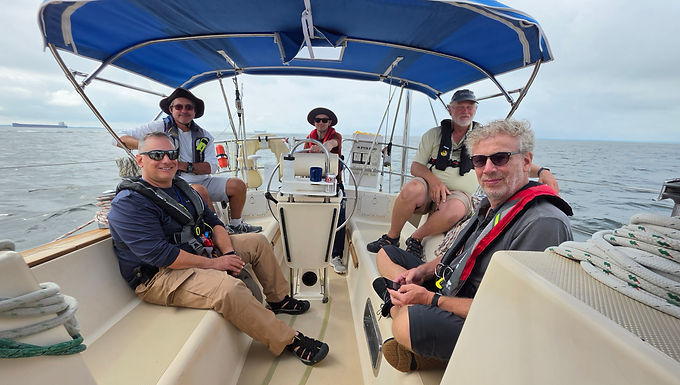
The crew started arriving a little after three on Friday evening and by 5:00, all four students, Peter, Gebhard, Tom and Will, the mate, Captain Jim and I were assembled at the boat and beginning our basic walk-through.  After a getting-to-know-you dinner ashore, the crew dispersed to various shoreside motels and we got a good night’s sleep.

On Saturday morning, we continued our examination of the boat and I discussed the roles each student would play over the week - navigator, bosun, engineer and emergency coordinator.  We went through the standing orders that would apply to the class and discussed what to do during various emergencies.  Then, after lunch, the crew spent the afternoon planning their route from Swan Creek Marina to the C&D Canal.  I had already done the route from Lankford Bay Marina to Swan Creek, but I knew that trip would have a lot of detours for training.  After a full day, the students once again dispersed to get dinner and pick up any last minute supplies or munchies for the trip.

Sunday morning dawned with a clear sky and, after walking through various sail handling drills at the dock, we went out into the open area near the marina and did a “compass deviation” data run.  We took on water and fuel and pumped out, then headed out for the Chester River.  After getting in the river, we set the main sail - despite the lack of wind - and performed COB drills in daylight.

The crew quickly got the hang of doing a COB on Navigator and we continued on our trip, arriving at Swan Creek a little before dark.  While the crew continued their navigation preps, I made dinner and we enjoyed it in the cockpit, before settling in for a beautiful sunset and off to bed aboard.

Morning came early and we were underway just after dawn.  Will was our “Skipper of the Day” and was able to get us going with a cheerful disposition.  Once underway, we discovered that today, much like Saturday, was going to be windless.  We proceeded up the Chesapeake Bay, into the Elk River and the C&D Canal. 

Jim kept the crew busy doing navigational problems to cement the practical skills that had been taught in the Coastal Navigation classroom.  Two and three bearing fixes and running fixes were the order of the day, along with attempts at “doubling the bow” and calculating distance off.

Upon our arrival at Schaefer’s Canal House marina, we found that the current in the canal required us to turn around and make a starboard side approach.  The crew handily did the maneuver and we were soon tied up at the dock.  While awaiting dinner, the crew continued with their navigation planning.  After a meal at the restaurant - literally steps from the boat - we settled in for the night and continued preparations for the next leg of our journey.

Dawn once again found us underway and headed for the Delaware River, with Skipper of the Day Tom leading the process.  Watching the sun come up over the bridges on the canal is always a lovely sight.  Soon we were in the Delaware River and headed south.  We had caught the tail end of the flood tide, so our going over ground was slow at first, but once we were in the Bay itself, we were riding the ebb current and doing more than 7 knots over ground.

Around dinner time, one of the crew noticed that we had not really had a lot of battery charge during the day, despite (once again) motoring.  I was alerted and did some basic troubleshooting, deciding the problem was a faulty battery in our main house bank.  I removed that battery from the bank, the charge came up and we continued.

When I came back on watch at 9:00 PM, the crew reported that we still weren’t getting a battery charge and that, since the sun had gone down and the solar panel had stopped supplying power, the battery charge had decreased even more.

By this point, we were about 10 miles out in the ocean, heading for our northern “offshore” waypoint.  Knowing that without a functioning charging system, we would soon be without lights and navigational equipment, I made the decision to turn around and head back into Lewes, Delaware.  Tom was on the wheel when we entered into the Lewes channel at about 2:00 AM and, with some guidance from our Lewes-based Captain Hattie, we found ourselves tied up at the Lewes Town Dock by three.  After bringing on shore power to recharge our batteries, we all crashed into a heavy sleep.  

Subsequent troubleshooting identified the problem as a bad ground connection between the Balmar alternator and the engine.  With some help from the crew, I was able to replace the corroded connection and subsequent testing indicated that the problem was (probably) resolved.

However, since there was no way to determine if the problem was actually fixed and having wind and weather predictions that indicated going south would be wet and lumpy, we discussed our options and decided to do the next leg to Annapolis back the way we had come.  That way, if the problem recurred, we would not be offshore with limited options for support.  Skipper of the Day Peter was in charge and we took the opportunity to do some sailing exercises before continuing our voyage.  We were able to perform controlled gybes, tacking with the cutter rig (a set of exercises that would prove fortunate before the end of the trip) and even doused the mainsail while still sailing on the headsail, an important offshore skill.

Once underway, we sailed up the Bay on the headsail, with the wind behind us on our port quarter.  Over the hours, the wind and waves increased and we were finally sailing well.  Unfortunately, we finally hit a combination of course and wind direction that precluded the further use of the headsail and we had to roll it in, continuing on the engine.  By this time, we were stemming the outgoing tide and our speed over the ground was down in the 3 knot range, despite a satisfactory 5.5 though the water.

We had had storms predicted for the day and at about 5:00, we hit a massive storm cell that did not want to let us pass.  Unlike most cells that tend to move, allowing us to basically hold position and let the cell leave us, this one was forming over the river and staying in one place.  The only way out of this cell was through it, so through it we went.

It took over two hours for us to pass from one side of the cell to the other.  While in it, we saw wind gusts of more than 40 knots and a pretty consistent 30 knots that shifted from our stern to our bow and back to our stern.  When the wind was on our bow, our speed over the ground would drop to 1.5 knots, prolonging the time we spent in the cell.  With shoals to our port and the shipping channel to our starboard, we had limited options for our course and the crew did their best to hold us on our heading.  At points, the heavy rain kept the visibility down to under one-half mile and blanked out the radar into a huge mass of red.  

Finally, around 7:30, the sky cleared, the rain stopped and the wind dropped back down to a respectable but manageable 20 knots.  We continued our trip and were in the C&D Canal a little after 9:00.  

We headed into the canal with the current on our bow, but by the time we had crossed the 15 or so miles, the current had changed and was now running with us.  Coming out of the C&D canal, we followed our navigation plan down the Bay, watching the water spread out and the clouds lighten above us.  Lightning to our west continued to show us where the big storms were.

At about one in the morning, the clouds had cleared to the point that we could see the moon, which was going through a near total lunar eclipse.  For an hour or more, we watched the moon disappear and then reappear.  As the lunar show wrapped up, the clouds thickened and darkened.  It was as if the entire show had been put on, just for us.

As we traveled down the Upper Chesapeake Channel toward Annapolis, we passed not one, but two aids to navigation that were not working.  Checking the Local Notice to Mariners determined that one had been listed, but the other was not.  We reported that condition after we got back to Lankford Bay Marina.

As the sun came up, we found ourselves passing under the Annapolis Bay Bridge and moving into the large ship anchorage area outside Annapolis Harbor.  Since we didn’t want to go into Annapolis until after noon, we continued down the western shore to the Thomas Point Shoal Light, then cut across the bay to the Bloody Point Bar Light on the eastern side.  Once there, we turned around and went back to the mouth of the Annapolis Harbor channel.  All morning, the water had been flat enough that we could see individual clouds reflected on its surface, but just as we got to the red #2 buoy, we began to see some ruffling and little wavelets.  We took this as a hopeful sign.

That afternoon, the students took the ASA-106 written exam and all successfully passed.  To celebrate, we took a water taxi into town and showers were taken.  Some of the crew wondered about carrying their shower gear to dinner afterwards, but as I explained, Annapolis has a long history of sailors wandering around with their shower gear tucked into a bag or backpack and the locals hardly give it a second glance.  This trip was no exception.

After dinner at the Iron Rooster (or was it breakfast?  IR has a very eclectic menu), we eventually all made our way back to the boat.  We found that the batteries were holding a great charge and we had no need to top off the house bank before bed.  It would seem that the fix applied in Lewes was the correct one (finally!).

Underway in the morning at four AM, we headed out into the Navy Anchorage to do our COB training at night.  Gebhard was our Skipper of the Day.  We did our Crew Overboard drills by having the two “off watch” people start in their bunks, with their PFDs off but nearby.  Then, I would send the rover below to stand in the galley while I turned on the mannequin’s strobe light and tossed it overboard.  The helmsman had to stop the boat, start the engine and get the crew on deck, all without losing sight of the mannequin in the water.  I can happily report that “Oscar” was successfully rescued all four times and we never ran him over with the boat.  

We finished up the COB training just as the sky was starting to lighten with the coming of the dawn and we headed toward the Bridge crossing under power.  After passing the bridge, we set the main and the genoa and started sailing to our waypoint, the LP mark near the Love Point end of Kent Island.  Because the wind was coming from that direction, we ended up doing a series of tacks up the Bay.  We would sail east until the depth sounder read 30 feet under the keel, then tack and run west until we were almost at the Craighill Channel.  This was where our tacking practice the previous day really paid off.  On our second approach, we actually had a large bulk cargo carrier coming down the channel, so we tacked a little early and finally made our waypoint on that leg.  Given that we now had to go directly into the wind, we furled the headsail and slid the traveler over slightly to keep the main from flogging, then motored to our next way point.  

After rounding Love Point, we reset our sails and continued to the red 12 buoy in the Chester River.  We had to furl our headsail there, but we were able to motor-sail up past the red 14 buoy, where we finally doused our mainsail and motored back to our marina.

Once back in our slip, the crew cleaned up the boat, diplomas were presented, ASA logbooks signed and the crew departed, happy and tired and, hopefully, with knowledge that they would use for the rest of their sailing careers.

The crew started arriving a little after three on Friday evening and by 5:00, all four students, Peter, Gebhard, Tom and Will, the mate, Captain Jim and I were assembled at the boat and beginning our basic walk-through. After a getting-to-know-you dinner ashore, the crew dispersed to various shoreside motels and we got a good night’s sleep.

On Saturday morning, we continued our examination of the boat and I discussed the roles each student would play over the week - navigator, bosun, engineer and emergency coordinator. We went through the standing orders that would apply to the class and discussed what to do during various emergencies. Then, after lunch, the crew spent the afternoon planning their route from Swan Creek Marina to the C&D Canal. I had already done the route from Lankford Bay Marina to Swan Creek, but I knew that trip would have a lot of detours for training. After a full day, the students once again dispersed to get dinner and pick up any last minute supplies or munchies for the trip.

Sunday morning dawned with a clear sky and, after walking through various sail handling drills at the dock, we went out into the open area near the marina and did a “compass deviation” data run. We took on water and fuel and pumped out, then headed out for the Chester River. After getting in the river, we set the main sail - despite the lack of wind - and performed COB drills in daylight.

The crew quickly got the hang of doing a COB on Navigator and we continued on our trip, arriving at Swan Creek a little before dark. While the crew continued their navigation preps, I made dinner and we enjoyed it in the cockpit, before settling in for a beautiful sunset and off to bed aboard.

Morning came early and we were underway just after dawn. Will was our “Skipper of the Day” and was able to get us going with a cheerful disposition. Once underway, we discovered that today, much like Saturday, was going to be windless. We proceeded up the Chesapeake Bay, into the Elk River and the C&D Canal.

Jim kept the crew busy doing navigational problems to cement the practical skills that had been taught in the Coastal Navigation classroom. Two and three bearing fixes and running fixes were the order of the day, along with attempts at “doubling the bow” and calculating distance off.

Upon our arrival at Schaefer’s Canal House marina, we found that the current in the canal required us to turn around and make a starboard side approach. The crew handily did the maneuver and we were soon tied up at the dock. While awaiting dinner, the crew continued with their navigation planning. After a meal at the restaurant - literally steps from the boat - we settled in for the night and continued preparations for the next leg of our journey.

Dawn once again found us underway and headed for the Delaware River, with Skipper of the Day Tom leading the process. Watching the sun come up over the bridges on the canal is always a lovely sight. Soon we were in the Delaware River and headed south. We had caught the tail end of the flood tide, so our going over ground was slow at first, but once we were in the Bay itself, we were riding the ebb current and doing more than 7 knots over ground.

Around dinner time, one of the crew noticed that we had not really had a lot of battery charge during the day, despite (once again) motoring. I was alerted and did some basic troubleshooting, deciding the problem was a faulty battery in our main house bank. I removed that battery from the bank, the charge came up and we continued.

When I came back on watch at 9:00 PM, the crew reported that we still weren’t getting a battery charge and that, since the sun had gone down and the solar panel had stopped supplying power, the battery charge had decreased even more.

By this point, we were about 10 miles out in the ocean, heading for our northern “offshore” waypoint. Knowing that without a functioning charging system, we would soon be without lights and navigational equipment, I made the decision to turn around and head back into Lewes, Delaware. Tom was on the wheel when we entered into the Lewes channel at about 2:00 AM and, with some guidance from our Lewes-based Captain Hattie, we found ourselves tied up at the Lewes Town Dock by three. After bringing on shore power to recharge our batteries, we all crashed into a heavy sleep.

Subsequent troubleshooting identified the problem as a bad ground connection between the Balmar alternator and the engine. With some help from the crew, I was able to replace the corroded connection and subsequent testing indicated that the problem was (probably) resolved.

However, since there was no way to determine if the problem was actually fixed and having wind and weather predictions that indicated going south would be wet and lumpy, we discussed our options and decided to do the next leg to Annapolis back the way we had come. That way, if the problem recurred, we would not be offshore with limited options for support. Skipper of the Day Peter was in charge and we took the opportunity to do some sailing exercises before continuing our voyage. We were able to perform controlled gybes, tacking with the cutter rig (a set of exercises that would prove fortunate before the end of the trip) and even doused the mainsail while still sailing on the headsail, an important offshore skill.

Once underway, we sailed up the Bay on the headsail, with the wind behind us on our port quarter. Over the hours, the wind and waves increased and we were finally sailing well. Unfortunately, we finally hit a combination of course and wind direction that precluded the further use of the headsail and we had to roll it in, continuing on the engine. By this time, we were stemming the outgoing tide and our speed over the ground was down in the 3 knot range, despite a satisfactory 5.5 though the water.

We had had storms predicted for the day and at about 5:00, we hit a massive storm cell that did not want to let us pass. Unlike most cells that tend to move, allowing us to basically hold position and let the cell leave us, this one was forming over the river and staying in one place. The only way out of this cell was through it, so through it we went.

It took over two hours for us to pass from one side of the cell to the other. While in it, we saw wind gusts of more than 40 knots and a pretty consistent 30 knots that shifted from our stern to our bow and back to our stern. When the wind was on our bow, our speed over the ground would drop to 1.5 knots, prolonging the time we spent in the cell. With shoals to our port and the shipping channel to our starboard, we had limited options for our course and the crew did their best to hold us on our heading. At points, the heavy rain kept the visibility down to under one-half mile and blanked out the radar into a huge mass of red.

Finally, around 7:30, the sky cleared, the rain stopped and the wind dropped back down to a respectable but manageable 20 knots. We continued our trip and were in the C&D Canal a little after 9:00.

We headed into the canal with the current on our bow, but by the time we had crossed the 15 or so miles, the current had changed and was now running with us. Coming out of the C&D canal, we followed our navigation plan down the Bay, watching the water spread out and the clouds lighten above us. Lightning to our west continued to show us where the big storms were.

At about one in the morning, the clouds had cleared to the point that we could see the moon, which was going through a near total lunar eclipse. For an hour or more, we watched the moon disappear and then reappear. As the lunar show wrapped up, the clouds thickened and darkened. It was as if the entire show had been put on, just for us.

As we traveled down the Upper Chesapeake Channel toward Annapolis, we passed not one, but two aids to navigation that were not working. Checking the Local Notice to Mariners determined that one had been listed, but the other was not. We reported that condition after we got back to Lankford Bay Marina.

As the sun came up, we found ourselves passing under the Annapolis Bay Bridge and moving into the large ship anchorage area outside Annapolis Harbor. Since we didn’t want to go into Annapolis until after noon, we continued down the western shore to the Thomas Point Shoal Light, then cut across the bay to the Bloody Point Bar Light on the eastern side. Once there, we turned around and went back to the mouth of the Annapolis Harbor channel. All morning, the water had been flat enough that we could see individual clouds reflected on its surface, but just as we got to the red #2 buoy, we began to see some ruffling and little wavelets. We took this as a hopeful sign.

That afternoon, the students took the ASA-106 written exam and all successfully passed. To celebrate, we took a water taxi into town and showers were taken. Some of the crew wondered about carrying their shower gear to dinner afterwards, but as I explained, Annapolis has a long history of sailors wandering around with their shower gear tucked into a bag or backpack and the locals hardly give it a second glance. This trip was no exception.

After dinner at the Iron Rooster (or was it breakfast? IR has a very eclectic menu), we eventually all made our way back to the boat. We found that the batteries were holding a great charge and we had no need to top off the house bank before bed. It would seem that the fix applied in Lewes was the correct one (finally!).

Underway in the morning at four AM, we headed out into the Navy Anchorage to do our COB training at night. Gebhard was our Skipper of the Day. We did our Crew Overboard drills by having the two “off watch” people start in their bunks, with their PFDs off but nearby. Then, I would send the rover below to stand in the galley while I turned on the mannequin’s strobe light and tossed it overboard. The helmsman had to stop the boat, start the engine and get the crew on deck, all without losing sight of the mannequin in the water. I can happily report that “Oscar” was successfully rescued all four times and we never ran him over with the boat.

We finished up the COB training just as the sky was starting to lighten with the coming of the dawn and we headed toward the Bridge crossing under power. After passing the bridge, we set the main and the genoa and started sailing to our waypoint, the LP mark near the Love Point end of Kent Island. Because the wind was coming from that direction, we ended up doing a series of tacks up the Bay. We would sail east until the depth sounder read 30 feet under the keel, then tack and run west until we were almost at the Craighill Channel. This was where our tacking practice the previous day really paid off. On our second approach, we actually had a large bulk cargo carrier coming down the channel, so we tacked a little early and finally made our waypoint on that leg. Given that we now had to go directly into the wind, we furled the headsail and slid the traveler over slightly to keep the main from flogging, then motored to our next way point.

After rounding Love Point, we reset our sails and continued to the red 12 buoy in the Chester River. We had to furl our headsail there, but we were able to motor-sail up past the red 14 buoy, where we finally doused our mainsail and motored back to our marina.

Once back in our slip, the crew cleaned up the boat, diplomas were presented, ASA logbooks signed and the crew departed, happy and tired and, hopefully, with knowledge that they would use for the rest of their sailing careers.

bottom of page